Why Your Analytics Data Should Pass Through Your Own Domain First
Why routing analytics events through a first-party collection domain gives businesses more control over data quality, consent enforcement, privacy risk, resilience, and vendor independence.
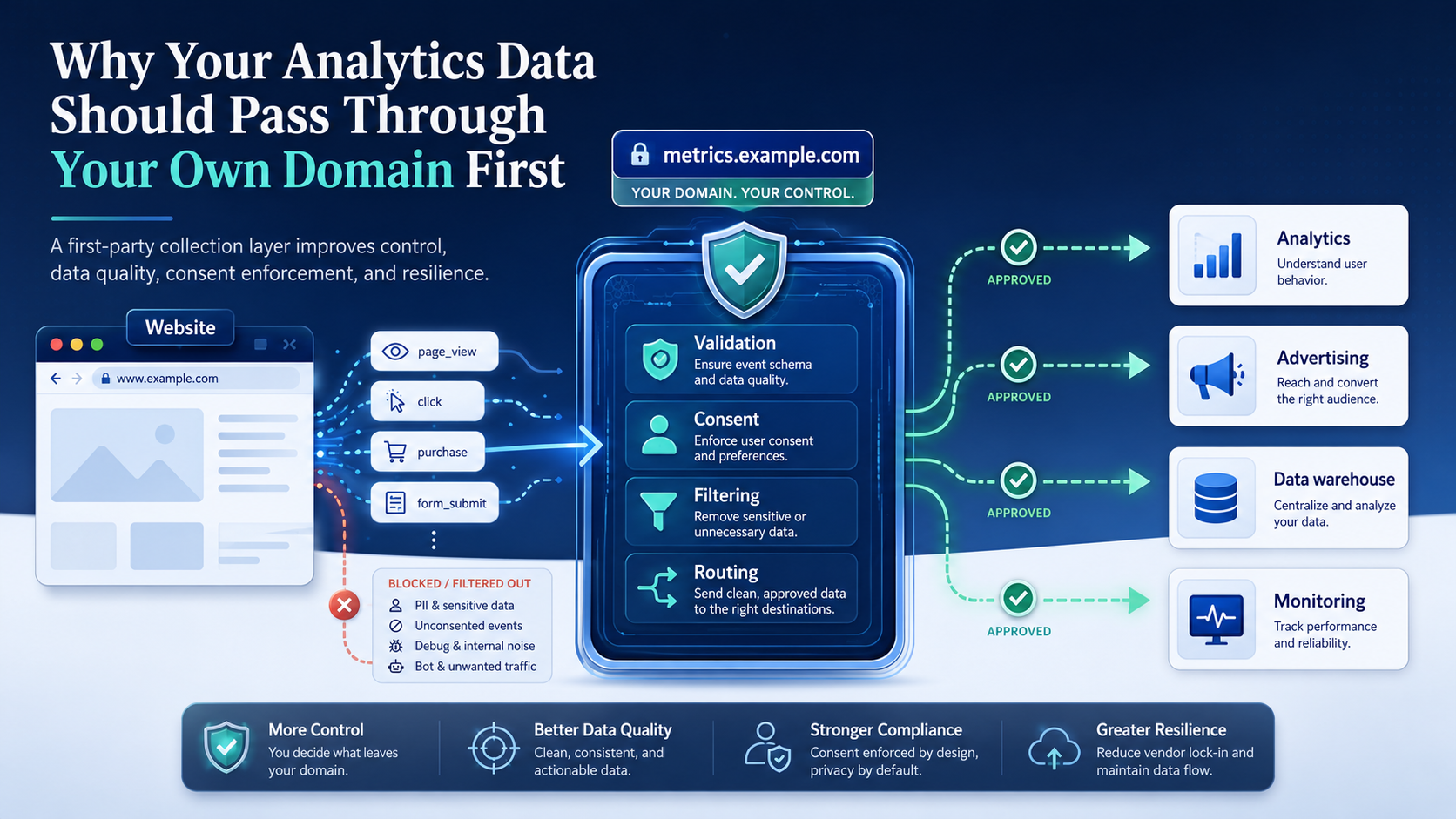
Most analytics implementations send data directly from the visitor’s browser to external platforms.
A typical setup may look like this:
Website
    ├── Google Analytics
    ├── Adobe Analytics
    ├── Google Ads
    ├── Meta
    └── Other marketing platforms
Every platform receives its own request directly from the browser.
This approach is relatively easy to implement, but it gives the business limited control over what leaves the website, how the data is validated, and where it is routed.
A more mature measurement architecture introduces a controlled first-party collection layer:
Website
    ↓
metrics.example.com
    ↓
Validation, consent, filtering and routing
    ├── Google Analytics
    ├── Adobe Analytics
    ├── Advertising platforms
    ├── Data warehouse
    └── Internal monitoring
Instead of sending every event directly to a third-party endpoint, the website first sends it to a domain associated with the business, such as:
metrics.example.com
collect.example.com
data.example.com
www.example.com/collect
That endpoint can then validate, transform, monitor and forward the event to approved destinations.
This is not simply a technical improvement. For businesses that depend on accurate digital data, it is an important step toward better measurement ownership.
What is a first-party collection domain?
A first-party collection domain is an endpoint using the company’s own website domain.
For example, if the main website is:
www.example.comthe analytics endpoint might be:
metrics.example.comor:
www.example.com/metricsThe second option uses a path on the same hostname. The first uses a dedicated subdomain.
Google supports both patterns for server-side tagging. Its documentation describes a same-origin path as the preferred configuration, while a first-party subdomain can also provide access to server-set cookie capabilities that are unavailable when using a default cloud-provider domain.
However, the domain name alone does not define the entire architecture.
There are several possible implementations.
1. A custom CNAME pointing to a vendor
metrics.example.com
    ↓
Vendor infrastructure
The request appears under the company’s domain, but the infrastructure behind it is still operated by the analytics vendor.
This is common with Adobe first-party data collection domains.
2. A reverse proxy or gateway
www.example.com/collect
    ↓
Company CDN or load balancer
    ↓
Vendor endpoint
The company’s infrastructure receives or proxies the request before forwarding it.
3. A real server-side collection layer
metrics.example.com
    ↓
Company-managed server-side container
    ↓
Multiple approved destinations
This provides the strongest level of control because the company can decide what data is accepted, modified, rejected, stored or distributed.
These approaches are related, but they are not identical.
A branded domain is useful. A company-controlled processing layer is more powerful.
Why sending data directly to every vendor is risky
When browser-side tags send information directly to several platforms, the website becomes tightly coupled to those platforms.
Each vendor may receive slightly different information. Each tag has its own configuration. Each script introduces another point of failure.
This creates several problems.
Limited control over outgoing data
Client-side tags may automatically collect information such as:
- full page URLs,
- query parameters,
- referrer values,
- browser information,
- campaign identifiers,
- user IDs,
- form values,
- transaction data,
- custom event parameters.
A poorly configured tag can accidentally send information that was never intended for that vendor.
This is especially dangerous when URLs or data layer objects contain email addresses, account identifiers, application numbers, internal product IDs or other sensitive values.
With a controlled collection layer, the business can inspect and modify the event before it reaches an external platform.
For example:
Incoming event:
page_location =
https://example.com/[email protected]

Processed event:
page_location =
https://example.com/application
The sensitive query parameter can be removed centrally instead of relying on every browser-side tag to handle it correctly.
A collection domain becomes a data quality gateway
One of the strongest reasons to introduce a first-party endpoint is data quality.
The collection layer can act as a gateway between the website and analytics vendors.
Before an event is forwarded, it can be checked against defined rules:
- Is the event name approved?
- Are all required parameters present?
- Are the parameter types correct?
- Is the event duplicated?
- Does the user’s consent state allow this destination?
- Does the payload contain prohibited fields?
- Is the environment production, staging or development?
- Should the event go to GA4, Adobe, the warehouse or several destinations?
Consider a purchase event:
{
  "event_name": "purchase",
  "order_id": "A-18492",
  "currency": "PLN",
  "value": "499.00"
}
The collection layer could validate that:
order_idis present,currencyfollows the expected format,valueis numeric,- the same order has not already been processed,
- no payment details are included,
- the event came from an approved hostname.
Only after validation would the event be forwarded.
Without that layer, every destination may receive the invalid payload and report it differently.
Google’s server-side architecture allows incoming requests to be converted into events and processed using server-side clients, tags, triggers and variables. Google also provides transformations that can include, exclude or modify parameters before tags receive them.
That changes analytics from simple event forwarding into governed data processing.
Better ownership and less vendor dependency
A browser implementation often uses vendor-specific formats directly in the website.
For example:
gtag("event", "generate_lead", {
  form_name: "enterprise_demo"
});
If the company later changes its analytics platform, the website implementation may also need to change.
A more durable architecture uses a vendor-neutral event contract:
window.dataLayer.push({
  event: "lead_submitted",
  form: {
    name: "enterprise_demo",
    type: "sales"
  }
});
The first-party collection layer can translate this event into the required format for each destination:
lead_submitted
    ├── GA4: generate_lead
    ├── Adobe: event42
    ├── CRM: lead_created
    └── Warehouse: fct_lead_events
The website communicates the business event once.
The collection layer handles vendor-specific translation.
This makes future migrations easier and prevents the website’s data model from becoming permanently tied to one analytics provider.
Greater measurement resilience
Browsers, privacy tools and content blockers increasingly restrict known tracking endpoints and scripts.
Using a first-party domain can improve measurement durability because the browser communicates with an endpoint associated with the website instead of connecting directly to several external hostnames.
Google recommends configuring server-side tagging on a first-party domain and supports loading Google scripts through first-party infrastructure using Google tag gateway for advertisers.
Adobe also supports a custom edgeDomain for Web SDK requests and states that using a custom domain can reduce the impact of ad blockers. Adobe notes, however, that Web SDK cookies are already set as first-party cookies regardless of the final collection domain.
This distinction is important.
A custom collection domain may improve resilience, but it does not guarantee complete data collection.
Browsers can identify CNAME-based tracker delegation. WebKit, the browser engine used by Safari, explicitly detects certain CNAME-cloaked requests and may restrict cookies or block known trackers in some browsing modes.
Therefore, a first-party domain should be treated as a legitimate architecture and governance improvement—not as a trick for hiding tracking.
Better privacy does not mean bypassing consent
A first-party collection endpoint does not remove privacy obligations.
It does not automatically make every downstream vendor a first party.
It does not mean that analytics or advertising data can be collected before the user’s consent when consent is required.
It does not change the purpose for which the data is processed.
The collection layer should enforce consent, not bypass it.
A stronger flow looks like this:
User interaction
    ↓
Consent state evaluated
    ↓
First-party collection endpoint
    ↓
Destination eligibility checked
    ├── Analytics allowed
    ├── Advertising blocked
    └── Essential monitoring allowed
For example, the same incoming event might be routed differently depending on the consent state:
Consent granted:
    → GA4
    → Adobe Analytics
    → Google Ads
    → Internal warehouse

Analytics only:
    → GA4
    → Adobe Analytics
    → Internal warehouse
    ✕ Google Ads

Consent denied:
    ✕ Analytics platforms
    ✕ Advertising platforms
    → Strictly necessary operational processing only
Google’s server-side consent implementation carries consent information from the website into the server container so that tags can adjust their behaviour. Adobe Web SDK similarly uses consent configuration to control whether data is sent to the Edge Network and when identity cookies are created.
The collection endpoint is therefore an enforcement point, not a replacement for a consent management platform.
Why this matters more for certain businesses
A first-party collection architecture can benefit almost any organization, but it becomes particularly important when measurement data affects revenue, customer trust or regulatory risk.
Financial services and insurance
Financial websites may track:
- quote applications,
- insurance product selections,
- account registration steps,
- loan or risk-calculation journeys,
- logged-in customer actions,
- document downloads.
URLs and data layer objects can contain application references, product details or account-related information.
A central processing layer can remove sensitive fields before sending approved analytics attributes to external platforms.
Healthcare and medical services
Healthcare websites require especially careful data minimization.
Search terms, appointment journeys, treatment pages and form interactions may reveal sensitive information even when a person’s name is not included.
Sending full URLs and unrestricted event parameters directly to multiple marketing vendors creates unnecessary risk.
A controlled endpoint can allowlist only the fields required for a clearly defined measurement use case.
Ecommerce and subscription businesses
For ecommerce, analytics data directly affects:
- campaign optimization,
- conversion attribution,
- automated advertising bids,
- product recommendations,
- revenue reporting.
Duplicate purchases, missing order IDs or incorrect values can distort both reports and advertising algorithms.
A server-side gateway can validate and deduplicate transactions before distributing them.
B2B lead-generation companies
B2B forms frequently collect:
- business email addresses,
- company names,
- job titles,
- phone numbers,
- lead identifiers.
These fields can accidentally enter the data layer or become attached to analytics events.
A central gateway can separate the information required by the CRM from the information permitted in analytics.
High-spend advertisers
When paid media platforms optimize campaigns using conversion signals, unreliable tracking becomes a financial issue.
A missing conversion event does not only affect a dashboard. It may change automated bidding, audience creation and budget allocation.
For these businesses, the collection endpoint should be treated as production infrastructure.
Large enterprises and multi-brand organizations
Enterprise websites often have many analytics properties, business units, agencies and technology vendors.
Without a central collection standard, every team may implement events differently.
A shared first-party endpoint can enforce:
- naming conventions,
- approved schemas,
- consent rules,
- destination rules,
- environment separation,
- data retention policies,
- monitoring standards.
This creates a common measurement contract across the organization.
Google Analytics implementation options
For companies using GA4, one of the main options is server-side Google Tag Manager.
A typical architecture is:
Website
    ↓
GTM web container
    ↓
metrics.example.com
    ↓
GTM server container
    ├── GA4
    ├── Google Ads
    ├── Meta
    └── Other APIs
The server container can run in Google Cloud or another supported environment.
Google describes server-side tagging as processing measurement data in a server environment controlled by the customer, where the customer can shape the data and choose where it is routed.
For a production implementation, the endpoint should not normally remain on a default address such as:
project-id.run.appIt should be mapped to a business-owned domain or routed through the website’s CDN or load balancer.
Adobe implementation options
Adobe customers can configure a first-party domain for Adobe Analytics or Adobe Experience Platform Web SDK.
For Web SDK, the request may look like:
Website
    ↓
data.example.com
    ↓
Adobe Experience Platform Edge Network
    ↓
Datastream
    ├── Adobe Analytics
    ├── Adobe Target
    ├── Adobe Experience Platform
    └── Event forwarding
Adobe recommends using a first-party domain in production Web SDK implementations. A CNAME can also be used with Adobe’s first-party device ID capabilities.
However, an Adobe CNAME should not be confused with a fully customer-operated server.
The domain belongs to the business, but the request may still be processed by Adobe infrastructure.
The Adobe datastream provides centralized destination configuration, while consent settings, XDM schemas and data governance determine how the information should be collected and used.
A custom domain is not enough by itself
Creating metrics.example.com does not automatically produce a mature architecture.
The endpoint still needs:
- clear ownership,
- TLS certificates,
- access controls,
- schema validation,
- consent enforcement,
- payload size limits,
- bot and abuse protection,
- monitoring,
- logging,
- alerting,
- release procedures,
- environment separation,
- disaster recovery planning.
It should also use a vendor-neutral name.
For example:
metrics.example.com
collect.example.com
events.example.com
is generally more flexible than:
google.example.com
adobe.example.com
A neutral name allows the business to change vendors without changing the endpoint embedded across the website.
A practical maturity path
Not every company needs to build a complex event gateway immediately.
A realistic migration can happen in stages.
Stage 1: Introduce a custom collection domain
Replace default third-party or cloud-provider endpoints with a domain associated with the website.
metrics.example.comThis creates a cleaner foundation and can improve measurement durability.
Stage 2: Add server-side processing
Introduce GTM Server, a reverse proxy, an event gateway or another controlled processing service.
Start with basic rules:
- remove unnecessary query parameters,
- reject unknown event names,
- block development traffic,
- validate purchase events,
- enforce consent,
- separate production and staging.
Stage 3: Create a vendor-neutral event contract
Define events according to business meaning rather than platform syntax.
product_viewed
quote_started
lead_submitted
account_created
subscription_renewed
Translate those events into GA4, Adobe, advertising and warehouse formats downstream.
Stage 4: Add monitoring and observability
Monitor:
- request volume,
- rejected events,
- endpoint latency,
- vendor response errors,
- duplicate transactions,
- missing parameters,
- unusual consent changes,
- sudden destination-level drops.
At this stage, the collection endpoint becomes part of the company’s measurement infrastructure rather than simply a forwarding URL.
Final thoughts
Using your own collection domain is not about making tracking invisible.
It is about making measurement more controlled.
The business should be able to answer:
- What data leaves our website?
- Which systems receive it?
- Was consent checked?
- Were sensitive values removed?
- Was the event validated?
- Can we detect failures?
- Can we change vendors without rebuilding the website?
- Do we have a reliable copy of the data for our own analysis?
A first-party collection domain creates the foundation for answering those questions.
For a small website with basic reporting, sending events directly to an analytics vendor may be sufficient.
But when analytics influences revenue, paid media, customer journeys, product decisions or executive reporting, direct browser-to-vendor tracking becomes increasingly fragile.
The more important the data is to the business, the less control the business should surrender over its collection.
A mature measurement system does not send data everywhere and hope it arrives correctly.
It collects data through a controlled entry point, validates it, applies consent and governance rules, and only then distributes it to approved platforms.